Quick Facts
- Recovery Benefit: Stimulates natural foot pumps to clear lactic acid and enhance circulation.
- Strength Gain: Research shows minimalist movement can increase foot strength by an average of 57.4 percent over six months.
- Structural Change: Improves navicular height by approximately 5.1 percent through consistent arch activation.
- Gait Impact: Encourages natural gait mechanics with shorter strides and increased knee flexion to reduce impact.
- Transition Period: A conservative 3-month window is recommended for safe physiological adaptation.
- Grounding Effect: Direct contact with the earth may reduce inflammation and speed up tissue repair.
Barefoot walking aids post-workout recovery by stimulating intrinsic foot muscles and ankle joints, which act as natural pumps to increase circulation and lymphatic drainage. This process helps clear metabolic waste like lactic acid while delivering oxygen to fatigued tissues. Direct contact with the Earth, known as grounding, can further reduce inflammation and speed up tissue repair after training. By ditching your supportive shoes, you activate the foot core system to enhance recovery and stability while restoring natural movement patterns.
The Natural Pump: Barefoot Walking for Post-Workout Recovery
As an athlete, you likely spend thousands of dollars on recovery tech—percussion massagers, compression boots, and cryotherapy tanks. But you are probably overlooking the most advanced recovery tool you own: your feet. When we talk about barefoot walking benefits for post-workout recovery, we are looking at the mechanics of the foot-ankle complex. This structure serves as a natural circulatory pump. Every time your bare sole hits the ground, the intrinsic foot muscles contract and relax, pushing blood and lymph back up toward the heart.
Traditional shoes, while protective, act like a cast. They limit this natural contraction, which can lead to stagnation in the lower extremities. By integrating barefoot movement into your cool-down, you facilitate superior lymphatic drainage and more efficient lactic acid clearance. This isn't just theory; barefoot walking aids post-workout recovery by stimulating the small muscles that act as natural pumps to enhance blood circulation and flush out metabolic waste.
Beyond the plumbing, there is the neurological component. Your feet are packed with tactile receptors that provide constant sensory feedback to your brain. After a grueling lower-body session, this feedback helps reset your central nervous system. Furthermore, many athletes find that grounding benefits of barefoot walking on grass provide an earthing effect. This direct contact with natural surfaces may help neutralize free radicals and lower systemic inflammation, providing a primitive yet effective way to accelerate tissue repair.
Restoring Natural Gait Mechanics and Balance
Most modern footwear is designed with a heel-to-toe drop and heavy cushioning. While this feels comfortable, it fundamentally alters your natural gait mechanics. It encourages a heavy heel strike and longer strides, sending a shockwave up the kinetic chain to your knees, hips, and lower back. When you remove the shoes, your body instinctively shifts. You naturally adopt shorter strides and increased knee flexion, which helps to reduce impact forces when the feet touch the ground.
This shift is crucial for long-term athletic performance. Barefoot walking for natural gait alignment forces you to engage the foot core system—a group of muscles that stabilize the arch and manage load distribution. Without the artificial support of an orthopedic insole, your brain must rely on proprioceptive awareness to determine where your body is in space.
Improved balance and proprioception through barefoot movement doesn't just make you more stable on your feet; it improves biomechanical efficiency throughout your entire kinetic chain. When your foot functions as a dynamic, sensory-rich foundation rather than a dead weight in a shoe, your arch activation improves. This creates a more stable platform for every squat, sprint, and jump in your training program.
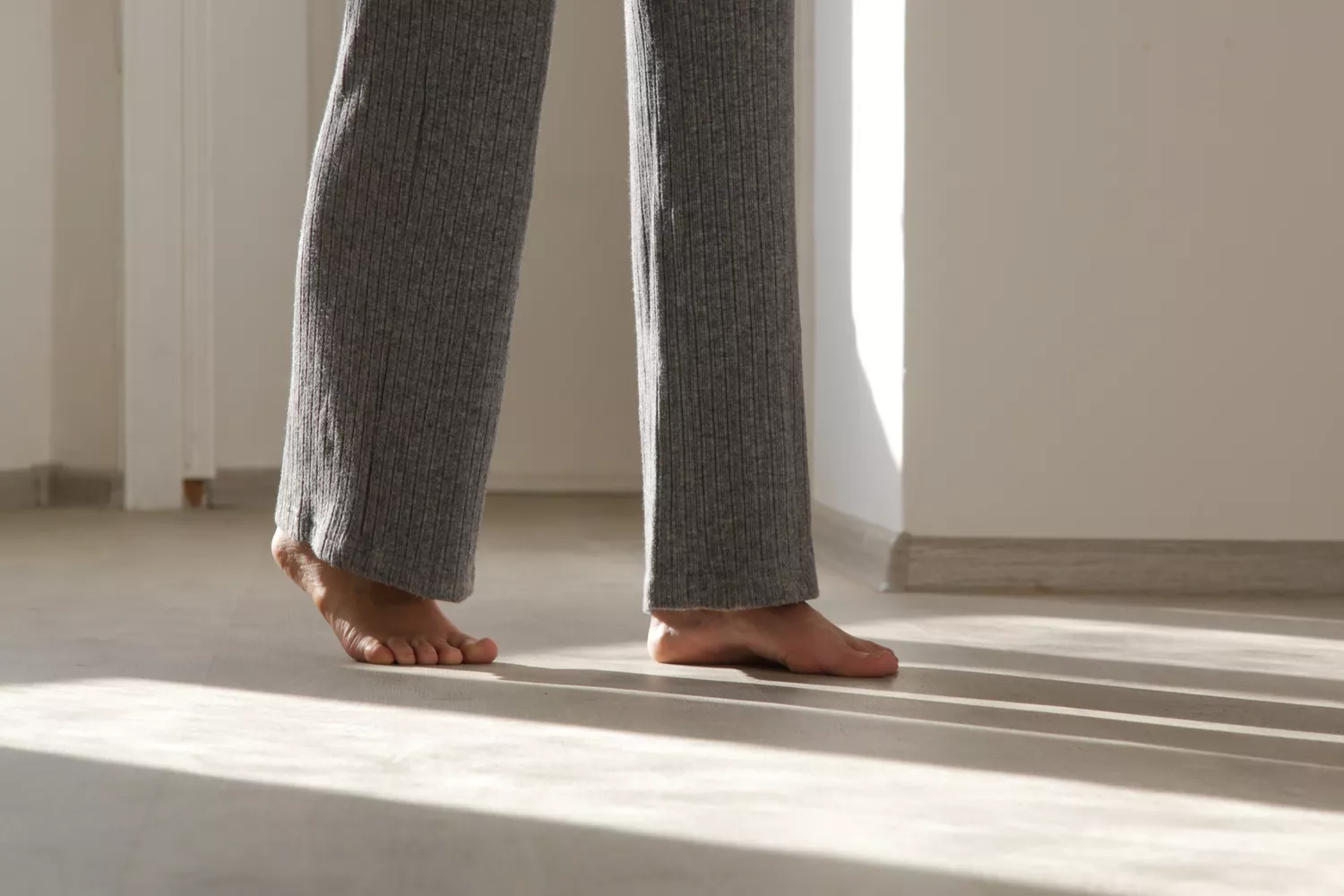
Strengthening the Foot Core: A 3-Month Transition Guide
You wouldn't attempt a 500-pound deadlift without training, and you shouldn't jump into a five-mile barefoot hike without preparation. The muscles in your feet have likely been dormant for years. A study found that people who transitioned to minimalist footwear for daily activities increased their foot strength by an average of 57.4 percent over six months. To reach that level safely, follow this structured barefoot transition guide.
-
Phase 1: Foundation (Weeks 1-4) Focus on indoor environments. Spend 10 to 20 minutes daily walking barefoot on hardwood or carpet. This is the time to perform foot strengthening exercises for barefoot transition, such as "towel scrunches" or "toe splaying." The goal here is simple arch activation and waking up the intrinsic foot muscles.
-
Phase 2: Expansion (Weeks 5-8) Take your practice outside to soft, predictable surfaces. The grounding benefits of barefoot walking on grass are perfect for this phase. Start with 15-minute sessions. You might also introduce minimalist shoes for short errands to begin building toe flexor strength and tolerance for varied textures without full exposure.
-
Phase 3: Confidence (Weeks 9-12) Gradually move to firmer or more varied terrains like packed sand or smooth forest trails. Monitor your body for any signs of metatarsal stress. By this point, your proprioceptive awareness should be significantly higher, allowing you to maintain a natural gait even on uneven ground.
| Feature | Traditional Footwear | Barefoot Movement |
|---|---|---|
| Stride Length | Longer, heel-strike dominant | Shorter, midfoot/forefoot strike |
| Muscle Engagement | Minimal (support-dependent) | High (intrinsic muscle focus) |
| Sensory Feedback | Muffled | Acute and constant |
| Impact Force | High (absorbed by joints) | Low (absorbed by muscles/tendons) |
| Arch Support | Passive (from shoe structure) | Active (from foot core) |
Environmental Safety and Risk Mitigation
While the benefits are clear, we must address the risks. Your feet are sensitive, and the modern world is not always barefoot-friendly. Choosing the best surfaces for barefoot walking practice is essential for avoiding injury. Soft grass, clean sand, and smooth indoor floors are your best friends. Avoid asphalt and concrete during the early stages, as these surfaces offer zero "give" and can be dangerously hot or littered with debris.
You must also listen to your body’s signals. A dull ache in the middle of the foot can be a sign of metatarsal stress, indicating that you are progressing too quickly. If you have a history of peripheral neuropathy or severe diabetes, consult a medical professional before starting, as reduced nerve stimulation or poor circulation requires a more clinical approach to foot health.
For those with existing issues like plantar fasciitis, barefoot walking precautions for plantar fasciitis include avoiding long durations on hard surfaces and focusing heavily on calf mobility. The goal is to strengthen the foot, not to overload a compromised structure. When done correctly, this practice restores the foot's structural integrity and reduces the long-term risk of lower-limb injuries.
FAQ
What are the health benefits of walking barefoot?
Walking barefoot improves foot strength, enhances balance through better proprioceptive awareness, and restores natural gait mechanics. It also aids in post-workout recovery by promoting lymphatic drainage and circulation via the foot-ankle pump.
How do I start walking barefoot safely?
Start slowly by spending 5 to 10 minutes walking barefoot on soft, indoor surfaces. Gradually increase the duration over several weeks and transition to soft outdoor surfaces like grass once your feet feel stronger.
Does walking barefoot help with flat feet?
Yes, it can help. By engaging the intrinsic foot muscles and encouraging arch activation, barefoot walking can improve the structural integrity of the foot and potentially increase navicular height, which supports the arch.
Is it better to walk barefoot on grass or sand?
Both have benefits. Grass offers a consistent, soft surface for grounding and recovery. Sand provides more resistance, which is excellent for strengthening foot muscles, but it can be more taxing on the tendons if you aren't accustomed to it.
Can walking barefoot improve your posture?
Absolutely. Barefoot walking encourages better body alignment by forcing the kinetic chain to stack correctly. When your feet are level with the ground rather than elevated by a heel, it reduces the forward tilt of the pelvis and helps align the spine.
Begin your journey today by spending just five minutes barefoot after your next workout. Your gait—and your recovery—will thank you.